Back to Blog
ORION: We Built a System That Tells You What Science Has Forgotten to Try

ORION: We Built a System That Tells You What Science Has Forgotten to Try
There is a version of scientific discovery that most people imagine: a researcher, deep in thought, makes a connection no one has made before. A flash of insight. A hypothesis forms. An experiment follows. A discovery happens.
That version is real. It still happens. But it is becoming rarer -- not because researchers are less capable, but because the mountain of prior work they have to climb before reaching the frontier keeps getting taller.
There are now over 200 million published scientific papers in existence. Two million more are added every year. No one reads all of them. No one comes close. And the tools built to help -- search engines, citation graphs, recommendation systems -- all share the same fundamental limitation: they are built to find what already exists.
None of them are built to find what is missing.
That is the problem we set out to solve.
The Moment No Tool Covers
Every researcher knows the moment we are talking about. You have done the reading. You have a general sense of the field. And now you have to decide: what should I actually test?
That decision -- the leap from literature to hypothesis -- is entirely unaided by any existing tool. It is the most important step in the research process, and it has been left entirely to intuition.
We do not think that is acceptable. Not anymore. Not when the literature is this large, the fields are this interconnected, and the cost of missing an obvious-in-retrospect connection is measured in years of delayed discovery.
ORION is our answer to that moment.
What We Built
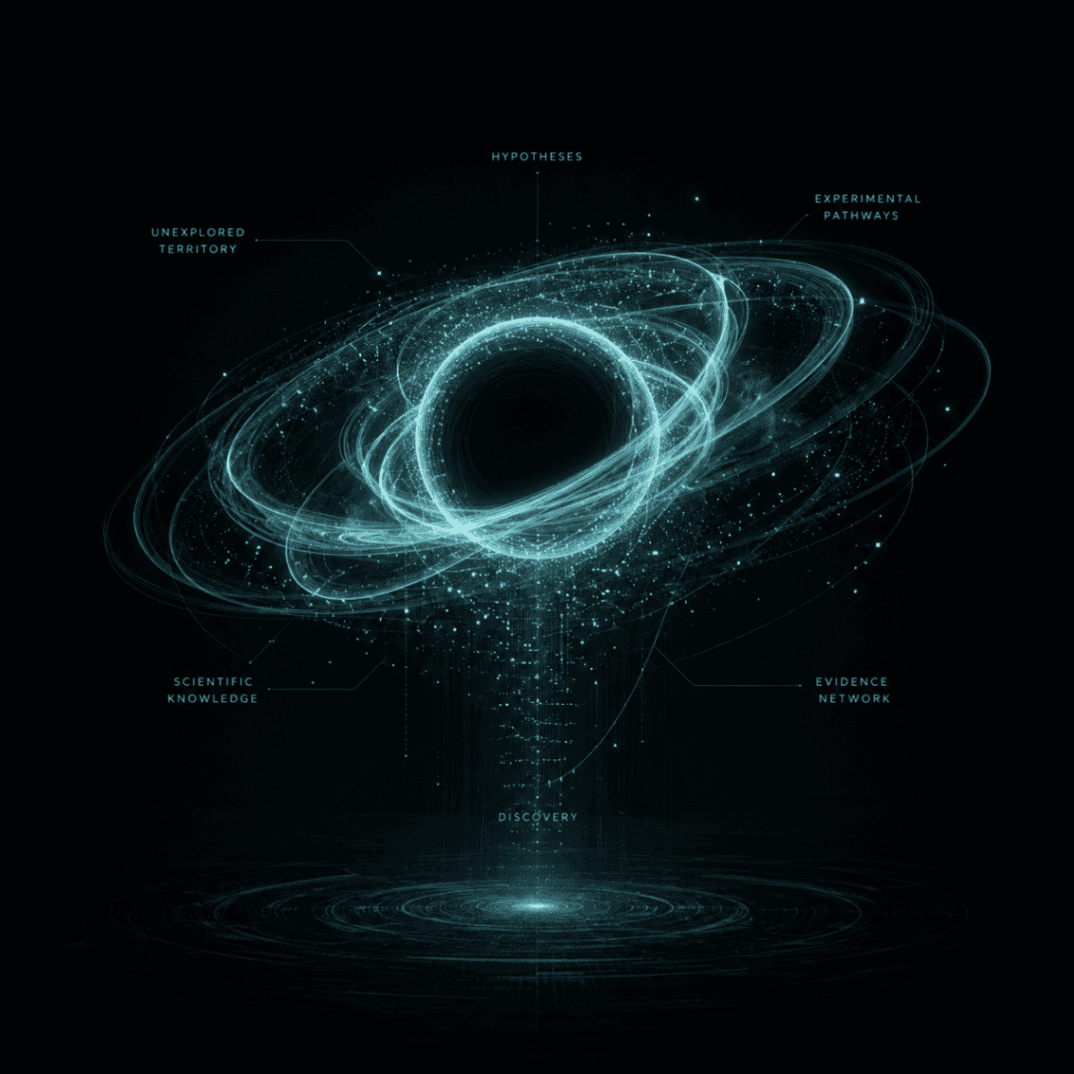
ORION reads the scientific literature of a field and builds a map of it -- a structured representation of what is known, where knowledge is concentrated, and where it thins out into unexplored territory.
It then analyzes that map for gaps: regions of scientific space that are surrounded by established research but have never been directly investigated. These are not random suggestions. They are locations in the structure of knowledge where the surrounding evidence implies something should exist, but no experiment has gone looking for it yet.
For each gap, ORION produces a hypothesis. Not a brainstorm. Not a language model completing a sentence. A specific, grounded, testable claim -- with a full experimental protocol and citations explaining why every step is justified by existing literature.
A researcher using ORION does not get a list of papers. They get a list of experiments that have never been run, ranked by how promising they are, with everything they need to start.
Why We Added Augmented Reality
We knew early on that surfacing hypotheses on a screen was not enough. The problem with reading about a knowledge map is the same problem with reading about a territory: it is fundamentally less useful than standing in it.
So we built glasses.
Prototype AR glasses that project ORION's knowledge map into the physical world around you. Clusters of well-studied research appear as dense, glowing regions in space. Sparse, unexplored territory appears as open space you can walk toward. Hypothesis candidates appear as paths. You reach out to select one. You speak to filter the view. The map responds.
This is not a visualization. Visualization implies something you look at. This is something you inhabit.
The reason spatial interaction matters is not aesthetic. It is cognitive. The human brain processes spatial relationships differently from text. Patterns that would take hours of reading to perceive become immediately obvious when knowledge has a physical shape. Researchers who have used the AR interface report understanding the structure of a field -- its gaps, its clusters, its frontiers -- in minutes rather than days.
We built the glasses from scratch. 3D-printed frame, a small display, a reflective surface that overlays the image on the real world, a microcontroller communicating with the researcher's phone. They are not a consumer product. They are a proof of concept for a form of interaction with knowledge that has not existed before.
Why We Think This Is Necessary
We want to be direct about this, because it would be easy to dismiss what we are building as a productivity tool -- something that makes an existing process slightly faster.
That is not what this is.
The scientific method, as it is practiced today, has a structural flaw at its most critical step. The formation of a hypothesis -- the decision about what to investigate -- is the least systematized part of the entire process. Everything that follows: experimental design, data collection, peer review, publication -- is governed by rigorous methodology. But the question of what to test is left to intuition, conversation, and luck.
The consequence is not just inefficiency. It is that the shape of what gets discovered is distorted. Fields that are fashionable attract more investigation. Cross-disciplinary connections go unmade because no one happened to read across the right boundary. Negative results -- experiments that fail -- get buried in lab notebooks instead of updating the shared map of what is worth trying.
ORION addresses all of this. It makes the hypothesis formation step systematic, evidence-grounded, and comprehensive. It learns from experimental outcomes, including failures. It builds a private record of a laboratory's unpublished knowledge -- the things that were tried, the things that did not work -- and factors that into every future suggestion.
The goal is not to replace researchers. The goal is to give them a complete view of the map they are already navigating, so that the choices they make with their expertise are made with full information rather than partial intuition.
Where We Are
ORION is in active development. The core system -- ingestion, mapping, hypothesis generation, protocol output -- is operational. The AR interface is a working prototype. The continuous learning loop is being built now.
We are researchers and engineers who believe that the next decade's most important scientific discoveries are already implicit in the literature that exists today. The evidence for them is there. The connections are there. They are waiting for a system that can see the whole map at once and point to what is missing.
That is what we built ORION to be.
ORION -- named for the hunter and the constellation. Not for what has been found. For the act of looking.
// Newsletter
Subscribe to Orion
Join our newsletter to receive occasional updates about new features, research, and platform improvements.